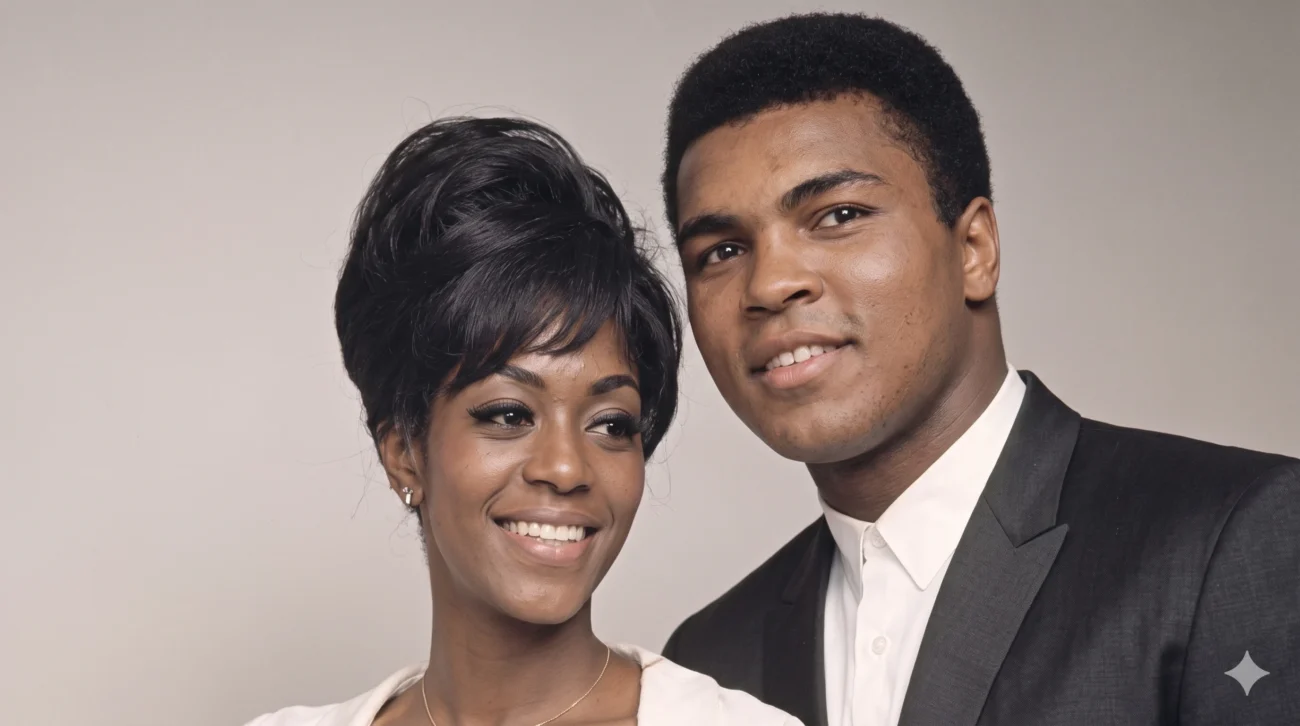
Sonji Roi is remembered most widely as Muhammad Ali’s first wife, but her life was not defined only by that brief, highly public marriage. She was a model, performer, and singer who entered Ali’s world at a moment when he was becoming one of the most famous and contested figures in America. Their relationship lasted less than two years, yet it remains part of the story of Ali’s rise, his religious identity, and the personal costs of fame.
Because Roi lived much of her later life privately, the public record is limited. Some details about her family, education, and finances are not publicly confirmed. What can be said with confidence is that she married Ali in 1964, separated from him during a tense period of religious and personal conflict, recorded music afterward under the name Sonji Clay, remarried, and died in Chicago in 2005.
Early Life and Background
Sonji Roi was born in 1945 in the United States. Public records and later memorial information identify her full later name as Sonji Roi Glover, reflecting her marriage after Muhammad Ali. Her early family life, parents, siblings, schooling, and childhood ambitions have not been widely documented in reliable public sources.
That lack of detail matters. Many short online biographies fill the gaps with claims that are hard to verify, but a careful biography should not treat repetition as proof. Roi was clearly part of the social and entertainment world around Chicago and Gary, Indiana, by the early 1960s, but the record does not support a full portrait of her upbringing.
Before she became famous through Ali, Roi was described publicly as a model. Some accounts also identify her as a cocktail waitress and performer. Those descriptions fit the public image she carried into her marriage: glamorous, independent, stylish, and unwilling to disappear quietly into someone else’s expectations.
Meeting Muhammad Ali
Sonji Roi met Muhammad Ali in 1964, a year that changed his life. In February of that year, Ali, then still widely known as Cassius Clay, defeated Sonny Liston and became world heavyweight champion. Soon after, his connection to the Nation of Islam became one of the most discussed facts about him.
Ali was young, famous, brilliant, controversial, and under constant public watch. Roi entered his life just as he was becoming more than an athlete. He was turning into a symbol of Black pride, religious conviction, political defiance, and generational change.
The relationship moved quickly. Roi and Ali married on August 14, 1964, in Gary, Indiana. Press accounts at the time described her as a 24-year-old model from Gary, while Ali was 22 and already one of the most talked-about men in the world.
Marriage to Muhammad Ali
The marriage between Sonji Roi and Muhammad Ali was brief, intense, and deeply shaped by the pressures around Ali’s public identity. They were not simply a young couple trying to build a private life. They were doing so while Ali’s name, religion, politics, and career were being argued about across the country.
The central conflict in the marriage is usually described as religious. Ali’s commitment to the Nation of Islam influenced what he expected from a wife. Roi did not accept those expectations, especially those connected to dress, public behavior, and conversion.
That conflict should not be reduced to a simple story of one person being right and the other wrong. Ali was in a period of deep personal transformation, and Roi was a young woman being asked to change the way she lived in order to fit a role she had not chosen for herself. Their disagreement was about faith, but it was also about freedom, control, identity, and the limits of marriage.
By 1966, the marriage was over. Some accounts describe the ending as a divorce, while others refer to an annulment. The safest public wording is that Sonji Roi and Muhammad Ali’s marriage ended in 1966, less than two years after their wedding.
Life in Ali’s Shadow
Sonji Roi’s public image was shaped by how people saw Muhammad Ali. That is one reason her story is often flattened. In many retellings, she appears only as “the first wife who would not convert,” a phrase that may capture part of the conflict but not the person.
Roi’s resistance mattered because it showed she was not willing to let marriage erase her own choices. She had her own style, her own social life, and her own sense of self. The available record does not give readers access to her private thoughts, but her actions show a woman who did not accept every demand placed on her.
Ali’s later life and reputation became far larger than the story of his first marriage. He became a global sports hero, an antiwar figure, a civil rights-era icon, and one of the most admired athletes of the twentieth century. Roi’s place in his biography stayed smaller, but it remains revealing because it shows Ali before the legend hardened, during a period when his private and public identities were still being tested.
Music Career as Sonji Clay
After her marriage to Ali ended, Sonji Roi pursued music under the name Sonji Clay. That professional name kept a link to the Ali period, since Ali had been born Cassius Clay, but her records also show an attempt to build a separate career in entertainment.
Her known singles appeared in the 1960s. They included soul and pop-soul recordings such as “Deeper In My Heart,” “I Can’t Wait (Until I See My Baby’s Face),” and “Here I Am And Here I’ll Stay.” These releases did not make her a major recording star, but they are important because they show Roi as more than a figure in Ali’s domestic life.
The music career also helps explain why her public image was not accidental. Roi understood performance, presentation, and attention. She was not a passive person caught only in someone else’s fame. She made her own attempt to be heard, even if the industry did not preserve her work as fully as it did the careers of bigger-name artists.
Second Marriage and Private Life
After Muhammad Ali, Sonji Roi later married Reynaldo Preston Glover, an attorney. In later public memorial records, she is identified as Sonji Roi Glover. Compared with her time as Ali’s wife, this later period of her life was much more private.
There is no reliable public record supporting a detailed account of her children, household, or day-to-day life after her second marriage. Some websites repeat claims about family members, but those claims are not consistently sourced. A careful profile should respect that boundary.
Her decision, whether active or circumstantial, to live outside the spotlight also deserves respect. Not every person touched by fame wants to keep performing for the public. Roi’s later privacy suggests a life that continued beyond the camera, even if much of it remains outside public view.
Net Worth and Income Sources
Sonji Roi’s net worth is not publicly confirmed. There is no reliable financial record showing her assets, income, inheritance, divorce settlement, music royalties, property, or later household wealth. Any exact figure attached to her name online should be treated with caution.
Her known income sources likely included modeling, entertainment work, and her recorded music, but the scale of those earnings is not publicly documented. Her second marriage to a lawyer does not create a basis for estimating her personal wealth. Biography sites that offer precise numbers without records are not reliable.
This is one area where saying less is more accurate. Roi was connected to a world of fame and celebrity, but connection to a famous person does not automatically establish wealth. Her financial life remains private.
Death and Public Memory
Sonji Roi Glover died in Chicago on October 11, 2005. Public memorial information lists her age as 59 and describes her death as due to natural causes. Some online summaries give different ages or causes, but those claims are not all supported with the same care.
Her death received limited public attention compared with the major events in Ali’s life. By 2005, Ali had long since become a global icon, and Roi was mainly remembered by boxing historians, Ali biographers, and readers interested in the women connected to his life.
Still, her memory has endured because her story reveals something important about the private side of public greatness. Ali’s first marriage shows how hard it can be for the people closest to a famous figure to keep their own identity intact. Roi’s refusal to be remade is one reason her name still draws interest.
Public Image and Legacy
Sonji Roi’s public image has often been shaped by contrast. She is remembered as glamorous where Ali’s religious circle expected modesty, independent where others expected obedience, and private where the Ali story became mythic. That contrast can be overstated, but it reflects the tension at the heart of her public life.
Her legacy is not built on a long list of awards or public offices. It rests instead on a brief but revealing moment in cultural history. She stood at the edge of sports, religion, race, celebrity, and womanhood in the 1960s, then moved away from the center of attention.
For readers today, Sonji Roi matters because she reminds us that the people around famous figures are not props. They have their own boundaries, ambitions, and losses. Her biography is short because the record is short, but it is still a life, not a footnote.
Frequently Asked Questions
Who was Sonji Roi?
Sonji Roi was Muhammad Ali’s first wife. She was also a model and singer who recorded music in the 1960s under the name Sonji Clay. Later in life, she was known as Sonji Roi Glover.
When was Sonji Roi born?
Sonji Roi was born in 1945. Her exact birth date is commonly listed as November 23, 1945, though readers should be aware that some biographical details about her early life are not well documented in major public sources.
When did Sonji Roi marry Muhammad Ali?
Sonji Roi married Muhammad Ali on August 14, 1964, in Gary, Indiana. Ali was 22 at the time and had recently become world heavyweight champion after defeating Sonny Liston.
Why did Sonji Roi and Muhammad Ali separate?
Their marriage ended largely because of conflict over religion, lifestyle, and personal expectations. Ali’s commitment to the Nation of Islam shaped his view of marriage, while Roi resisted changing her dress, behavior, and beliefs to meet those demands.
Did Sonji Roi have children?
Children are not publicly confirmed in the strongest available biographical record. Some online sources make claims about family, but those details are not consistent enough to state as verified fact.
What was Sonji Roi’s net worth?
Sonji Roi’s net worth is not publicly confirmed. There are no reliable records showing her personal wealth, music earnings, divorce settlement, or later finances, so exact figures should be treated as speculation.
When did Sonji Roi die?
Sonji Roi died in Chicago on October 11, 2005. Public memorial information lists her age as 59 and describes her death as due to natural causes.
Conclusion
Sonji Roi’s life is often viewed through Muhammad Ali’s story, but that is not the only way to understand her. She was a young woman with her own style and ambitions who became attached to one of the most famous men in the world at a moment of intense change.
Her marriage to Ali was short, but it exposed real questions about faith, independence, gender, and public pressure. Roi’s refusal to surrender her identity made her a memorable figure in Ali’s early life, even though she did not seek decades of celebrity afterward.
The most respectful reading of Sonji Roi is also the most careful one. She should not be inflated into a legend or reduced to a conflict in someone else’s biography. She remains a distinct figure whose brief public story still speaks to the cost of being close to greatness.
