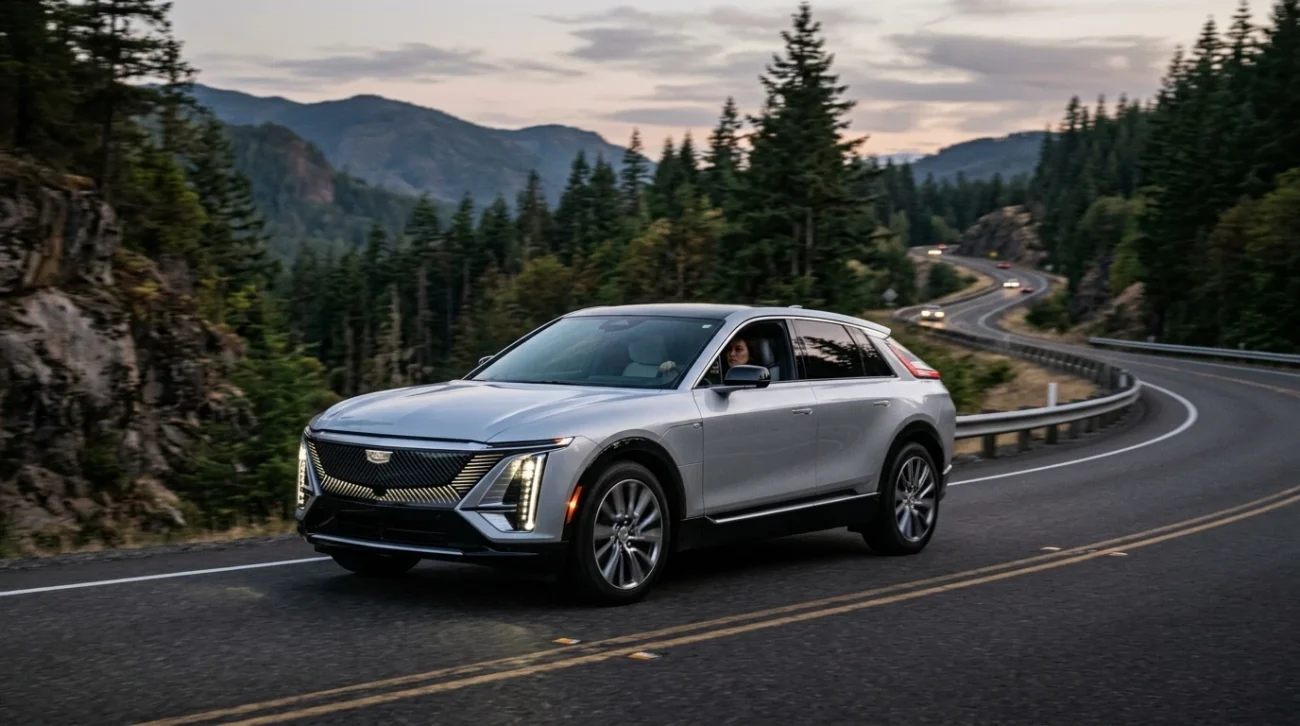
The Cadillac LYRIQ’s driving modes can affect real-world battery consumption, but they do not give the vehicle separate official range ratings. Choosing Tour, Sport, Snow/Ice, or My Mode changes how the LYRIQ responds to the driver, including accelerator response, steering behavior, and traction characteristics. It doesn’t switch the battery between different capacities or unlock a separate pool of driving range.
For 2026, Cadillac lists up to 326 miles of EPA-estimated range for the rear-wheel-drive LYRIQ and up to 319 miles for certain all-wheel-drive versions. Those differences come from vehicle configuration, not from selecting a different driving mode. The EPA does not publish one range figure for Tour and another for Sport.
There is still an efficiency connection. Sport can encourage stronger acceleration and greater power demand, while Tour provides calmer everyday behavior. Snow/Ice reduces acceleration and torque response to help manage traction, and My Mode lets the driver customize several responses. The resulting battery use depends heavily on what the driver actually does with those settings.
The 2026 LYRIQ-V adds an important exception. Its Velocity Max performance feature is specifically documented by Cadillac as drawing more energy from the battery than normal driving. That distinction helps explain the broader issue: ordinary drive modes mostly change vehicle behavior, while certain high-performance functions can make a more direct demand on available battery energy.
How Cadillac LYRIQ driving modes affect range
A driving mode is best understood as a group of vehicle settings rather than a battery-range selector. The LYRIQ’s standard modes include Tour, Sport, Snow/Ice, and My Mode. Each changes aspects of the driving experience, but Cadillac does not assign each one a separate EPA-estimated range.
That distinction matters because the range shown in advertising or on an EPA label comes from standardized vehicle testing. The EPA evaluates specific configurations of the LYRIQ, which is why rear-wheel-drive and all-wheel-drive versions can carry different figures. It does not provide a separate certification every time the driver chooses a different response setting.
For 2026, Cadillac lists the LYRIQ battery at 102 kWh of rated energy capacity. Selecting Sport instead of Tour does not shrink that capacity, just as returning to Tour doesn’t physically add energy to the battery.
What can change is the rate at which the stored energy is consumed. A mode that makes the accelerator respond more aggressively can make high power demand easier to request. A gentler calibration can make smooth driving easier, which may improve efficiency in everyday use.
That is why two statements that appear contradictory can both be true: the LYRIQ’s driving modes don’t have different official ranges, but the modes can contribute to different real-world battery consumption.
Tour Mode
Tour is the standard choice for normal driving and is the most sensible starting point for a LYRIQ owner concerned about efficiency. Cadillac describes Tour as an everyday setting, and its general Driver Mode guidance identifies Tour/Normal as the most economical mode.
That doesn’t mean Tour adds a fixed number of miles. Cadillac has not published a claim such as “Tour provides 15 more miles than Sport,” and there is no verified universal percentage improvement.
Instead, Tour’s value comes from the way the vehicle responds. A calmer accelerator calibration can make it easier to accelerate progressively rather than repeatedly demanding large bursts of power from the electric motors.
On a long trip, however, the word “Tour” on the display cannot overcome other sources of energy consumption. Highway speed, temperature, wind, road grade, climate control, vehicle load, tire condition, and driving habits can all affect how far the LYRIQ travels on a charge.
Sport Mode
Sport changes the LYRIQ’s character by providing more immediate torque response and different steering behavior. That quicker response is what creates the potential efficiency tradeoff.
Electric motors can deliver large amounts of torque immediately. If Sport encourages the driver to accelerate harder or more frequently, the vehicle will draw more energy during those periods and practical range can decrease.
The key point is that Sport does not appear to impose a documented fixed range penalty simply because it has been selected. A driver could choose Sport and then maintain a steady, moderate cruising speed. Another could repeatedly exploit the sharper response and consume energy much faster.
Cadillac does not publish a universal Sport-versus-Tour range percentage for the standard LYRIQ. Claims that Sport always cuts range by a specific number of miles or a specific percentage therefore need independent controlled testing before they should be treated as fact.
For owners, that makes driving behavior more useful to watch than the mode name. If Sport changes how you use the accelerator, it can change your consumption. If it doesn’t materially change your behavior, the difference may be much smaller.
Snow/Ice Mode
Snow/Ice Mode has a different purpose. Cadillac designed it to help control wheelspin on slippery surfaces, with reduced acceleration and torque response helping the driver apply power more progressively.
That gentler response might sound like an efficiency feature, but Snow/Ice should not be treated as an alternative Eco mode. Its job is traction management.
There is another complication: drivers normally select Snow/Ice under exactly the conditions that can reduce electric-vehicle range. Low temperatures can affect battery performance, while cabin heating consumes energy. Snow, slush, winter tires, road conditions, and other environmental factors can add further resistance.
Federal testing has shown substantial cold-weather range losses for EVs under demanding test conditions, particularly when cabin heating is included. Those findings are not a prediction of exactly how much range every LYRIQ will lose, but they show why blaming Snow/Ice Mode for a winter range decrease can be misleading.
If a LYRIQ travels fewer miles per charge during a freezing week while Snow/Ice is active, the mode may not be the main reason. The weather and road conditions that prompted its use may matter far more.
My Mode
My Mode makes a simple mode-to-range comparison even harder because the driver can personalize vehicle behavior. Cadillac allows adjustments that can include accelerator responsiveness, steering feel, braking response, and Electric Vehicle Sound Enhancement.
As a result, one owner’s My Mode configuration may feel relaxed while another’s is deliberately sporty. There is no single My Mode calibration from which a meaningful universal range figure could be calculated.
Cadillac does not publish a separate EPA range for My Mode. If energy efficiency is the goal, accelerator response and the driver’s resulting behavior are more useful things to consider than the My Mode label itself.
What affects LYRIQ range more than the drive-mode selector
The LYRIQ’s hardware configuration creates a measurable difference before driving style even enters the equation. For the 2026 model year, Cadillac lists up to 326 miles of EPA-estimated range for rear-wheel drive and up to 319 miles for an all-wheel-drive configuration. Cadillac also lists a 303-mile estimate for another AWD configuration equipped with the available higher-capacity AC charging hardware.
EPA efficiency data reflects those differences. The 2026 rear-wheel-drive model is listed at roughly 37 kWh per 100 miles in combined driving, while AWD configurations are listed around 38 or 40 kWh per 100 miles depending on configuration. These are certified vehicle differences, not Tour-versus-Sport figures.
Speed can produce another major change. An electric vehicle has to overcome increasing aerodynamic resistance as speed rises, so sustained high-speed highway driving can require substantially more energy than moderate-speed travel. The EPA figures for the 2026 RWD LYRIQ reflect this pattern, with efficiency rated higher in city testing than in highway testing.
Climate control can also consume energy that would otherwise be available for propulsion. Heating becomes especially relevant in winter, when the vehicle may simultaneously face colder battery temperatures and greater cabin-heating demand.
Cadillac’s own vehicle energy information is useful here because it can show owners energy consumption and efficiency and identify effects associated with climate use, battery conditioning, and driving habits. That provides a better diagnostic tool than assuming every movement in the estimated-range display was caused by the selected drive mode.
Terrain matters as well. Climbing requires energy, while descending can allow some energy to be recovered through regenerative braking. Strong headwinds, wet or snow-covered roads, tire pressure, additional cargo, and repeated hard acceleration can further change consumption.
This is why a LYRIQ in Tour isn’t guaranteed to beat one in Sport on every journey. A Sport-mode vehicle driven smoothly at moderate speed in mild weather could consume less energy than a Tour-mode vehicle driven rapidly into a cold headwind with heavy cabin heating.
Regenerative braking is separate from driving modes
One-Pedal Driving and Regen On Demand often enter discussions about LYRIQ modes because both can change how the SUV feels. They are separate from Driver Mode Control.
Regenerative braking allows the electric motors to recover some kinetic energy while the vehicle slows. Instead of converting all of that motion into heat through the friction brakes, the drivetrain can convert part of it back into electrical energy and store it in the high-voltage battery.
The LYRIQ’s One-Pedal Driving system allows the vehicle to decelerate as the driver releases the accelerator. Regen On Demand gives the driver additional control through a steering-wheel paddle. Cadillac presents regenerative braking as a feature that can help improve driving efficiency and recover energy that would otherwise be lost.
There are limits. Regeneration cannot recover all of the energy previously used to accelerate the vehicle, so accelerating unnecessarily and then regenerating does not produce free range. Driving smoothly and avoiding needless changes in speed remains preferable from an energy perspective.
Regenerative capability can also be restricted under some battery conditions. Cadillac warns that regenerative features may behave differently when the battery is fully charged or when battery temperature is extremely high or low, with conventional braking blended in when necessary.
For drivers trying to maximize range, this distinction is useful. Tour versus Sport may influence how readily you request power, while regenerative braking affects what happens when the vehicle slows. Both can influence efficiency, but they do so in different ways.
Why the LYRIQ’s displayed range can change
The estimated range shown inside an EV is easy to interpret as a measurement of how much battery remains, but battery state of charge and estimated driving distance aren’t the same thing. The battery contains a certain amount of usable energy at a given state of charge; the distance that energy can cover depends on how quickly the vehicle is consuming it.
If recent driving has required more energy, an estimated-range calculation can respond accordingly. Climate use, driving habits, battery conditioning, speed, temperature, and road conditions can all contribute to changing consumption.
That is why switching to Sport and later seeing fewer estimated miles doesn’t by itself prove that Sport has a preset range penalty. If the driver also accelerated more aggressively after selecting Sport, the vehicle now has evidence of greater energy use.
The reverse can happen after a period of efficient driving. A favorable range estimate doesn’t mean the battery gained capacity; it means the available energy appears capable of carrying the vehicle farther under the conditions reflected by the estimate.
Owners who want to understand what is happening should therefore pay attention to energy efficiency over repeated journeys rather than reacting to every small movement in the estimated-range number.
How to compare Tour and Sport in your own LYRIQ
The most useful Tour-versus-Sport test is one performed under repeatable conditions. Cadillac’s vehicle information tools can display energy consumption and average efficiency, giving owners data that is more meaningful than impressions about how quickly the range estimate moved.
Start by comparing repeated drives on a route you travel regularly. Similar temperatures, traffic, cabin settings, starting battery conditions, tire pressures, and speeds will make the comparison more meaningful. If one test occurs in mild weather and another during a cold snap, the result says little about the drive modes themselves.
Driving style also needs to remain similar. Testing Tour with gentle acceleration and then treating the Sport run as a performance demonstration guarantees an efficiency difference, but it doesn’t isolate what the mode itself changed.
Average miles per kilowatt-hour, or the equivalent energy-consumption information shown by the vehicle, provides a clearer comparison. If Tour repeatedly returns better efficiency over similar journeys, that tells you something useful about how Tour works with your driving habits.
The result still shouldn’t be presented as a universal LYRIQ figure. Another driver on different roads, in different weather, with a different configuration may get a different result.
For a road trip where maximizing distance between charging stops matters, Tour remains the logical default. Smooth acceleration, sensible cruising speed, appropriate climate settings, correct tire pressures, and planning charging stops are likely to be more useful than repeatedly changing modes in search of extra miles.
The 2026 LYRIQ-V and Velocity Max are different
The performance-focused 2026 Cadillac LYRIQ-V makes the battery-use question more interesting because it includes features beyond the standard LYRIQ’s ordinary modes.
Cadillac rates the 2026 LYRIQ-V at 285 miles of EPA-estimated range. It uses dual-motor all-wheel drive, and Cadillac says Velocity Max enables an estimated 615 horsepower and 650 lb-ft of torque. With Velocity Max and Launch Control, Cadillac quotes a 0-to-60-mph time of 3.3 seconds.
Velocity Max is important because Cadillac directly addresses its energy consumption. The company says the feature unlocks additional horsepower and torque from the battery and electric drive units and draws more energy than regular driving. Repeated use can therefore deplete the battery faster.
That is a much clearer statement than Cadillac makes about ordinary Sport Mode. Sport changes the standard LYRIQ’s response characteristics, while Velocity Max is a performance function designed to extract additional output and has a documented effect on energy demand.
The LYRIQ-V also offers V-Mode for configurable performance settings. Owners comparing information about a standard LYRIQ with information about the LYRIQ-V should therefore be careful not to assume that every mode or feature operates in the same way.
The distinction also explains why the LYRIQ-V’s EPA range should not be used to estimate the effect of selecting Sport in a standard LYRIQ. The V is a different performance model with its own drivetrain tuning, equipment, performance capability, and EPA certification.
Common misunderstandings about LYRIQ modes and battery use
One of the biggest misunderstandings is that changing modes changes the amount of electricity physically stored in the battery. It doesn’t. Cadillac lists the 2026 standard LYRIQ battery at 102 kWh of rated energy capacity, and selecting Sport, Tour, Snow/Ice, or My Mode does not change that figure.
Another is that Tour should produce the advertised EPA range under all circumstances. EPA estimates are standardized figures designed to help compare vehicles. Actual distance per charge varies with weather, speed, terrain, climate use, driving behavior, loading, battery condition, and other factors.
Sport also isn’t synonymous with an automatic fixed range reduction. Its more immediate response can lead to higher consumption, but Cadillac has not published a standard percentage by which Sport reduces LYRIQ range. An exact claim without controlled supporting data should be treated cautiously.
Snow/Ice creates the opposite misconception. Because it reduces acceleration and torque response, drivers may assume it is secretly an Eco setting. Cadillac positions it as a traction-oriented mode for slippery conditions, not as a method of extending range.
One-Pedal Driving presents another source of confusion. It can recover energy through regenerative braking, but it is not one of the LYRIQ’s standard driving modes. Regeneration and Drive Mode Control are separate vehicle systems even though both influence the driving experience.
Finally, comparisons between standard LYRIQ modes and the LYRIQ-V’s Velocity Max can be misleading. Cadillac explicitly says Velocity Max uses additional battery energy. That statement should not be automatically applied to every selectable setting in every LYRIQ.
Frequently Asked Questions
Do Cadillac LYRIQ driving modes have different official ranges?
No. Cadillac does not publish separate EPA range ratings for Tour, Sport, Snow/Ice, and My Mode. Official range varies by vehicle and powertrain configuration rather than by the mode selected while driving.
Which Cadillac LYRIQ mode is best for range?
Tour is the most sensible default if efficiency is the priority. Cadillac’s general Driver Mode guidance identifies Tour/Normal as the most economical setting, but Cadillac does not promise a specific number of additional miles compared with Sport.
Does Sport Mode drain the LYRIQ battery faster?
It can if the sharper accelerator response leads to harder or more frequent acceleration. Cadillac does not publish a fixed battery-consumption or range penalty for Sport Mode on the standard LYRIQ, so there is no verified universal percentage to quote.
Does Snow/Ice Mode improve LYRIQ range?
Snow/Ice isn’t designed as a range-extending mode. It reduces acceleration and torque response to help control wheelspin on slippery surfaces, while the cold and snowy conditions in which it is normally used can themselves reduce EV efficiency.
Does One-Pedal Driving save battery?
One-Pedal Driving can recover some energy through regenerative braking when the LYRIQ slows. It can’t recover all energy previously spent accelerating, and regenerative braking can be limited under certain battery-temperature or state-of-charge conditions.
Why does my LYRIQ range estimate change after driving?
Estimated range reflects more than the amount of charge remaining. Recent energy consumption, climate use, temperature, speed, battery conditioning, terrain, and driving behavior can all affect how far the vehicle estimates it can travel.
Does the LYRIQ-V’s Velocity Max use more battery?
Yes. Cadillac specifically says Velocity Max draws more energy than regular driving because it unlocks additional horsepower and torque from the battery and electric drive units. This is different from the standard LYRIQ’s ordinary Sport Mode, for which Cadillac does not publish a fixed additional energy-use figure.
Conclusion
Cadillac LYRIQ driving modes can influence battery consumption, but they should not be thought of as separate range settings. Tour, Sport, Snow/Ice, and My Mode change how the standard LYRIQ responds; they don’t create four different battery capacities or four official EPA range figures.
For drivers trying to maximize distance, Tour is a sensible default, but the larger gains are likely to come from the basics: moderate speeds, smooth acceleration, thoughtful climate use, appropriate tire pressure, and awareness of weather and road conditions. Looking at actual energy efficiency over repeated trips will tell you more than watching the estimated-range display immediately after changing modes.
The 2026 LYRIQ-V’s Velocity Max is the clear exception to the broader pattern because Cadillac explicitly states that it draws additional battery energy. That makes it important to distinguish a high-output performance feature from the normal drive modes offered in the standard LYRIQ.
The practical answer is simple: LYRIQ drive modes can change how efficiently you end up driving, but they don’t come with their own fixed ranges. How far the vehicle travels still depends much more on the configuration, conditions, speed, climate demands, and the way the driver uses the performance available.
