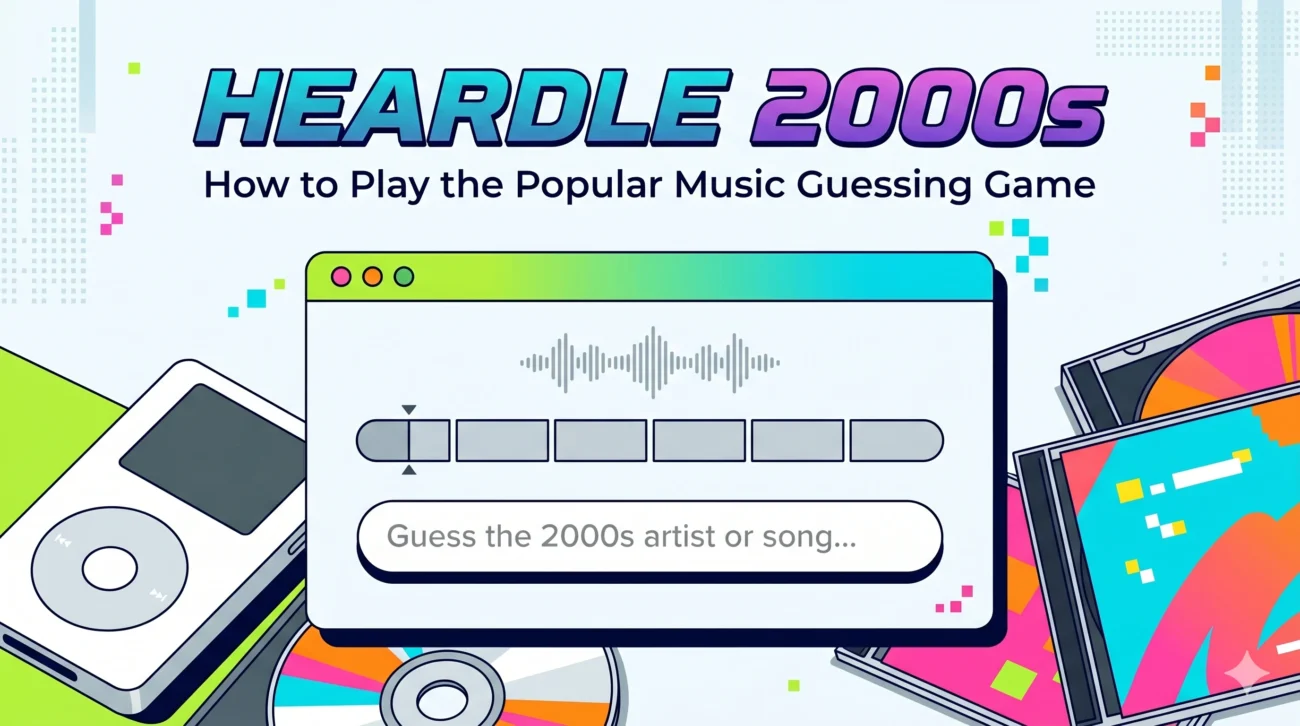
Heardle 2000s is a music guessing game built around a simple challenge: identify a song from the 2000s after hearing only its opening seconds. For many players, the appeal is instant. One drum hit, synth line, guitar riff, or vocal ad-lib can bring back a song that once lived on radio, MTV, iPods, burned CDs, club playlists, school dances, and early YouTube.
The main thing to know is that Heardle 2000s is not the original Spotify-owned Heardle. The original Heardle was created by Omakase Studios, acquired by Spotify in July 2022, and shut down after May 5, 2023. The versions of Heardle 2000s that players find online now are unofficial Heardle-style games that use the same basic format with a decade-specific song pool.
That distinction matters because it explains both the popularity and the confusion around the search. People looking for “heardle 2000s” usually want to play, learn the rules, find out why the old Heardle disappeared, or check whether today’s versions are official. The answer is practical: you can still find 2000s music guessing games online, but they should be understood as clone or fan-style experiences rather than a revived Spotify product.
What Heardle 2000s is
Heardle 2000s is a browser-based song identification game focused on music from the 2000s. The game plays a short clip from the beginning of a track, then asks the player to guess the song title. If the player skips or guesses wrong, more of the song is revealed.
Most versions follow the familiar Heardle structure: six chances to identify the song, with the clip growing longer after each attempt. The best score comes from naming the track after the shortest possible listen. That makes the game less about deep music theory and more about recognition, memory, and the sound of a specific era.
The 2000s focus gives the game a clear identity. Instead of drawing from all pop history, it narrows the field to a decade shaped by pop, hip-hop, R&B, rock, emo, indie, dance music, and early digital music culture. For players who grew up with that music, the game feels like a quick test of personal memory as much as a trivia challenge.
The exact song list depends on the site. Some versions lean toward major chart hits, while others include a wider mix of genres and artists. Since these games are unofficial, their libraries are not always public, stable, or consistent from one version to another.
How the game works
A typical round begins with a very short audio clue. The player listens, types a guess into a search field, and chooses from the available song options. If the answer is correct, the round ends and the player can see how quickly they solved it.
If the player is wrong, the game gives another chance and extends the audio. Skipping has the same basic effect: the clip gets longer, but the player uses up one of the limited attempts. The tension comes from deciding whether to guess early or wait for a clearer clue.
Autocomplete is an important part of the experience. It helps players avoid losing because of spelling, punctuation, featured artists, or title formatting. But it also exposes one of the limits of these games: if the song is not in the database or appears under a different title, a player may struggle even when they know the answer.
The format rewards attention to tiny details. A clipped guitar sound may point to garage rock. A polished beat may suggest 2000s R&B or pop. A digital synth tone may bring to mind the ringtone era, while a dramatic piano intro may send the player toward power ballads, emo, or arena pop. The more familiar someone is with the decade’s production styles, the better they tend to play.
Why people search for Heardle 2000s
The first reason is simple: people want to play. Heardle had a clean, addictive format, and the 2000s version gives that format a clear theme. It suits a quick daily habit, a group chat challenge, or a casual break.
The second reason is nostalgia. The 2000s are now far enough away to feel like a defined period, but close enough that many listeners still have vivid memories tied to the music. A song from that decade might recall a first phone, a school bus ride, a college party, a TV soundtrack, a mall playlist, or a shared family computer loaded with downloaded tracks.
The third reason is confusion about the Heardle brand. Spotify acquired Heardle in July 2022, then ended the game in 2023. Since many Heardle-style sites still exist, users often assume they are connected to Spotify or to the original game. In most cases, they are not.
That confusion is understandable. The name, rules, and visual style can look familiar across different sites. But the current Heardle 2000s pages should be treated as separate web games, not as an official continuation of the original Heardle service.
The background: from Heardle to decade games
Heardle became popular during the wider boom in daily browser puzzles. Wordle had shown how a simple once-a-day format could become part of people’s routines. Heardle took that idea and swapped letters for music.
The concept worked because it was easy to explain. Instead of solving a word, players identified a song from its intro. The daily format made it social, because everyone could compare how quickly they recognized the same track.
Spotify’s July 2022 acquisition put Heardle inside a major music company. Spotify described the game as a music trivia experience that could help listeners rediscover songs and find artists. That made sense on paper: a guessing game could connect naturally to streaming.
But the official Heardle did not last. Spotify ended the service after May 5, 2023, saying it was focusing on other music discovery features. Players were told to save their stats before the shutdown, which confirmed that the original game was not simply moving to a new home.
After that, Heardle became less a single product and more a format. Unofficial versions appeared around decades, genres, artists, and themes. Heardle 2000s belongs to that second life: not the original, but a continuation of the idea by other sites.
Why the 2000s fit the format so well
The 2000s were a strong decade for recognizable intros. Many hits were built to grab attention quickly, whether through a guitar riff, a producer tag, a vocal entrance, a drum pattern, or a bold synth line. In a game where the opening seconds matter most, that helps.
The decade also covered a wide mix of listening habits. People still bought CDs, but they also downloaded songs, made playlists, watched music videos online, shared files, and carried thousands of tracks on early MP3 players. Music was becoming more portable and more personal, but radio and television still shaped what became widely known.
That mix makes the game feel broad without feeling random. A player might hear a pop hit, a rock anthem, an R&B single, a dance track, or a rap song and still feel that it belongs to the same cultural period. The best 2000s clues do not just ask whether the player knows a title; they ask whether the player remembers how the decade sounded.
There is also a generational pull. For people who were children, teenagers, or young adults during the 2000s, the songs carry emotional weight. The game turns that memory into a small test, and that makes a correct answer feel more satisfying than a normal trivia response.
Benefits, risks, and practical limits
The main benefit of Heardle 2000s is that it is fast. A round can be played in a few minutes, and the rules are easy to grasp without instructions. That makes it accessible to casual players who may not want a long quiz or a full music app experience.
It is also social. The fun often comes from comparing results with friends, especially when one person recognizes a song in one second and another needs the full clip. Because the 2000s mean different things to different listeners, the game can also reveal gaps in taste, age, region, and genre memory.
The game can prompt real music rediscovery. A missed answer may send a player back to an old album, a forgotten artist, or a playlist of songs they have not heard in years. That is one reason the Heardle format made sense for a streaming company, even though Spotify later shut down the original game.
There are limits. Unofficial sites may change, disappear, or break without warning. Audio previews may fail if the source changes access. A player’s streak or stats may not be worth preserving if the site does not have long-term support.
There are also privacy and trust concerns. A simple web game should not need unusual permissions, downloads, or personal data. Players should be cautious if a Heardle 2000s site asks for anything beyond normal browser interaction.
Common misunderstandings about Heardle 2000s
The biggest misunderstanding is that Heardle 2000s is an official Spotify game. It is not, based on the verified history already available. Spotify bought the original Heardle in 2022 and shut it down in 2023.
Another common misunderstanding is that all Heardle 2000s sites are the same. They may share the same format, but they can differ in song selection, design, answer handling, ads, archives, and daily versus unlimited play. A frustrating experience on one site does not mean the whole format is broken.
Some players also assume that “2000s” means every song from 2000 through 2009 is equally likely. In practice, many versions appear to favor recognizable songs, because the game works best when the answer is known by a broad audience. That can make the song pool feel more like a popular memory of the decade than a full record of the decade’s music.
A final misunderstanding involves difficulty. Heardle 2000s may sound easy if someone knows the era well, but intros can be deceptive. Many songs from the same period share production habits, and the first second can point to several possible answers.
Frequently Asked Questions
Is Heardle 2000s the same as the original Heardle?
No. The original Heardle was created by Omakase Studios, acquired by Spotify in July 2022, and shut down after May 5, 2023. Heardle 2000s games available now are unofficial Heardle-style versions focused on songs from the 2000s.
How do you play Heardle 2000s?
You listen to a short clip from the start of a song and try to guess the title. If you skip or guess incorrectly, the game reveals more of the track. Most versions give players six chances.
Is Heardle 2000s free?
Most Heardle 2000s versions found online are free browser games. That said, free sites may include ads or redirects. Be cautious with any site that asks for payment, downloads, or unnecessary permissions.
Why did Spotify shut down Heardle?
Spotify ended the original Heardle after May 5, 2023. The company said it was focusing on other music discovery features. That shutdown is why current Heardle 2000s games should not be treated as official Spotify products.
What kind of songs are in Heardle 2000s?
The song pool depends on the site. Most versions focus on recognizable 2000s tracks across pop, rock, R&B, hip-hop, dance, indie, and related genres. The full libraries are not always public.
Can I play more than one Heardle 2000s puzzle per day?
It depends on the version. Some sites follow the daily puzzle model, while others offer unlimited rounds. Daily play is better for sharing results with friends, while unlimited play is better for practice or parties.
What is the best way to win?
Listen for the sound of the intro before guessing. Drums, guitar tone, synth texture, vocal timing, and production style can narrow the answer quickly. If the first second is too vague, skipping once may be smarter than wasting a guess.
Conclusion
Heardle 2000s works because it turns music memory into a quick, satisfying challenge. The format is simple, but the feeling behind it is powerful: a tiny piece of audio can bring back a whole period of listening.
The most important fact is that today’s Heardle 2000s games are not the original Heardle. Spotify acquired that game in 2022 and ended it in 2023. What remains is a group of unofficial versions that keep the format alive for players who still enjoy it.
For anyone searching the term, the next step is practical. Choose a clean, easy-to-use version, avoid sites that ask for too much, and do not assume your streak will last forever. The real value is the play itself: the moment a forgotten song comes back before the title has even reached your tongue.
