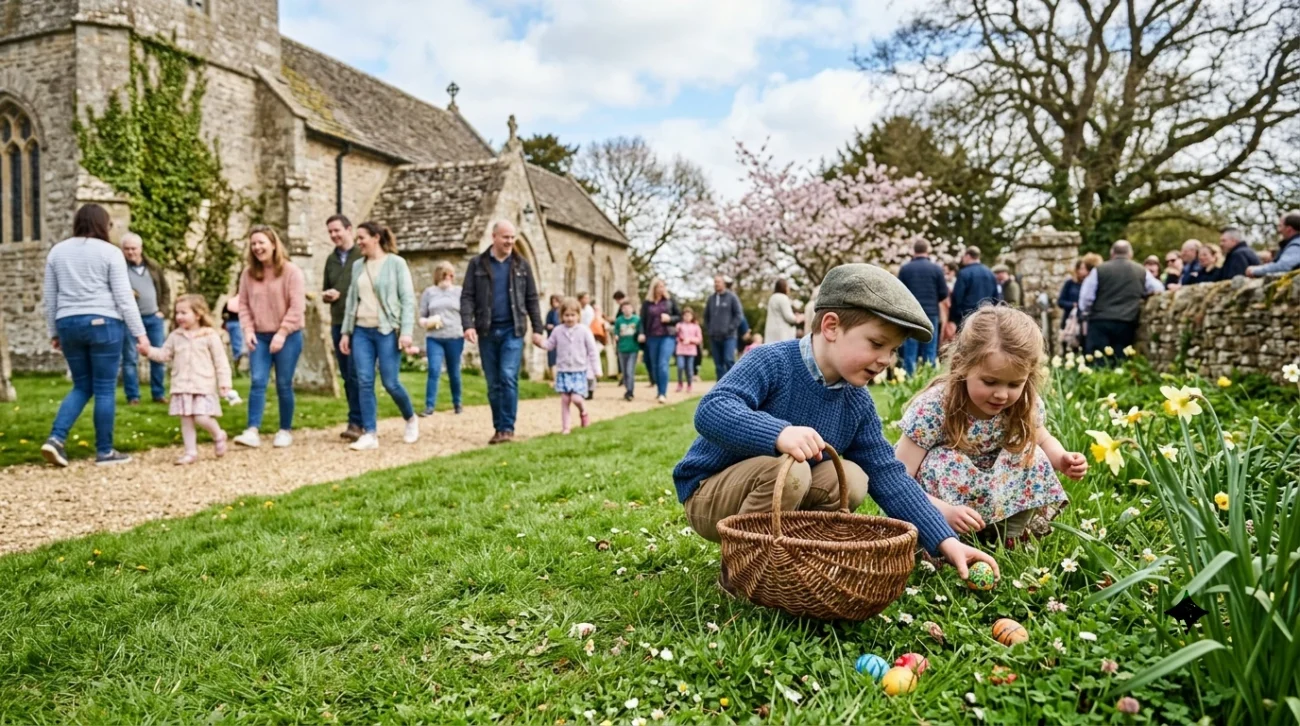
Easter traditions bring together religious worship, family gatherings, seasonal food, public ceremony, children’s games, and centuries of local custom. For Christians, Easter marks the resurrection of Jesus Christ and stands at the center of the faith’s liturgical calendar. For many other people, it is also a cultural holiday shaped by decorated eggs, chocolate, special meals, spring flowers, and time spent with relatives.
There is no single way to celebrate Easter. A family in Greece may attend a midnight service and crack red-dyed eggs, while a family in Poland may take a basket of food to church for a blessing. In Bermuda, children and adults fly handmade kites on Good Friday. In the United States, Easter may include a sunrise service, an egg hunt, a ham dinner, or all three.
These customs come from different periods and places. Some grew directly from Christian worship, some developed from fasting rules and agricultural life, and others spread through migration, folklore, publishing, and commerce. Understanding Easter traditions means seeing how religious meaning and cultural practice have developed together without assuming that every custom has one simple origin.
What Easter Celebrates
Easter commemorates the resurrection of Jesus after his crucifixion. In Christian belief, the resurrection represents victory over death and the promise of new life. That is why Easter is treated not as a minor annual observance but as the most important celebration in the Christian calendar.
The day is part of a longer religious cycle. Lent, a season of prayer, fasting, repentance, and charity, prepares believers for Holy Week. Palm Sunday recalls Jesus’ entry into Jerusalem, Maundy Thursday remembers the Last Supper, and Good Friday marks the crucifixion. Easter Sunday then celebrates the resurrection.
In Catholic tradition, the period from the evening of Holy Thursday through Easter Sunday is known as the Paschal Triduum. The Easter Vigil, usually held after dark on Holy Saturday, is one of its central services. It often begins with fire and candlelight, followed by Scripture readings, baptisms, the renewal of baptismal promises, and the first Eucharist of Easter.
Eastern Orthodox Christians commonly call the holiday Pascha, a word connected to Passover. Orthodox services often begin late on Saturday and continue toward midnight, when the resurrection is proclaimed. Worshippers light candles, exchange the greeting “Christ is risen,” and take the flame home.
Easter does not end on Sunday evening in the church calendar. In many Christian traditions, the Easter season lasts 50 days and concludes with Pentecost. This longer period keeps the focus on the resurrection, the ascension of Jesus, and the coming of the Holy Spirit.
Why Easter Falls on a Different Date Each Year
Easter is a moveable feast, so its date changes from year to year. In Western Christianity, it falls on the Sunday after the Paschal full moon, the ecclesiastical full moon that occurs on or after March 21. This means Western Easter can fall between March 22 and April 25.
The calculation is based on church tables rather than direct observation of the moon. The system developed from early Christian efforts to establish a shared date for the celebration. The First Council of Nicaea in 325 is closely tied to the decision that Easter should be observed on a Sunday under a common method.
Most Catholic and Protestant churches now use the Gregorian calendar for the calculation. Many Eastern Orthodox churches continue to use methods based on the older Julian calendar. Because the calendars and lunar tables differ, Western Easter and Orthodox Pascha may fall on the same day or on separate Sundays.
The difference was clear in recent years. Western and Eastern Christians celebrated Easter together on April 20, 2025. In 2026, Western Easter fell on April 5, while Orthodox Pascha was observed on April 12.
Church leaders have discussed the possibility of a shared date for decades. The 1,700th anniversary of the Council of Nicaea in 2025 renewed those conversations, but no universal agreement followed. Calendar reform touches church authority, inherited practice, and identity, so even a practical change can carry deep religious concerns.
How Eggs and Rabbits Became Easter Symbols
Eggs are among the oldest and most widespread Easter symbols. They have represented life and renewal in many cultures, and Christians later connected them with the sealed tomb and the emergence of new life. The symbolism was easy to understand and adaptable across regions.
Fasting rules helped make eggs part of Easter practice. In medieval Europe, eggs were often among the foods restricted during Lent. Eggs laid during the fasting season could be preserved, decorated, blessed, given away, or eaten after the fast ended.
Different cultures developed their own egg traditions. Greek Orthodox families commonly dye eggs red, a color associated with the blood of Christ. The egg itself represents the tomb and resurrection, while egg-tapping games turn the symbol into a family ritual.
In Poland and Ukraine, decorated eggs can become detailed works of folk art. Ukrainian pysanky use a wax-resist method in which the maker applies wax, dyes the egg, adds another layer of wax, and repeats the process. The finished patterns may carry religious, regional, family, or protective meanings.
Chocolate eggs appeared much later. Advances in chocolate production during the 19th century made hollow molded eggs easier to manufacture. The old symbol remained, but the product became linked to commercial gift-giving and the confectionery trade.
The Easter Bunny has a different history. Rabbits and hares have long been associated with fertility and spring because of their rapid reproduction, but the familiar claim that the Easter Bunny came directly from an ancient goddess is not supported by clear historical evidence.
A stronger link can be found in German-speaking folklore. Stories described a hare that brought eggs or judged children’s behavior. Children prepared nests where the hare could leave gifts, and German immigrants carried versions of the custom to North America.
Over time, the hare became a softer, more humanlike rabbit. Publishers, advertisers, toy makers, and chocolate companies helped create the basket-carrying Easter Bunny familiar today. The figure is now common in secular Easter celebrations, though many Christian families treat it as separate from the religious meaning of the holiday.
Easter Food, Worship, and Family Customs
Easter food often reflects the end of a fast. After weeks of avoiding meat, dairy, eggs, alcohol, or rich foods, depending on church rules and personal practice, the Easter meal marks a return to celebration. This helps explain why many traditional dishes are rich, sweet, or centered on meat.
Lamb is common in Mediterranean and European traditions, partly because of its biblical symbolism. Ham became closely associated with Easter in parts of Northern Europe and North America. Eggs, cheese, butter, cakes, sausages, roasted meats, and seasonal vegetables appear in different combinations.
Special breads are also common. Greece has tsoureki, a sweet braided bread often served with red eggs. Britain is known for hot cross buns, especially on Good Friday. Italy, Eastern Europe, and the Balkans have many regional breads enriched with eggs, butter, cheese, sugar, or fruit.
Family recipes often matter more than official menus. A dish may survive because a grandparent made it every year, not because every person in the country eats it. Migration also changes recipes as families replace hard-to-find ingredients, adjust cooking methods, or combine customs from different backgrounds.
Church services shape the weekend for many households. Some attend a solemn Good Friday service, then return for the Easter Vigil late on Saturday. Others prefer a sunrise service on Sunday, based on the Gospel accounts of women arriving at the tomb early in the morning.
Public processions remain central in countries such as Spain, Italy, Mexico, and the Philippines. In Spain’s Semana Santa observances, religious brotherhoods carry large sculptures of Jesus, Mary, and scenes from the Passion through city streets. These events attract visitors, but they remain acts of worship and community memory, not simply performances.
Charity is another traditional part of the season. Churches and families may provide food, money, or practical help to people in need. The connection between fasting, giving, and feasting reminds participants that Easter celebration is not meant to be limited to private comfort.
Easter Traditions Around the World
Easter customs often reveal how a community combines faith, local history, climate, food, and public life. The same religious event may be expressed through candles in one place, water in another, and handmade kites somewhere else.
Greece
Greek Orthodox Easter builds toward the midnight service on Holy Saturday. Churches darken, worshippers light candles, and the resurrection is proclaimed at midnight. Bells, fireworks, and public greetings may follow, creating a moment that is both religious and communal.
Red eggs, tsoureki, soup, and lamb are common parts of the celebration. Many families break the fast immediately after the service, then hold a larger meal on Easter Sunday. Regional customs vary, so one island’s public spectacle should not be treated as a national rule.
Poland
In Poland, many families prepare baskets of food for a Holy Saturday blessing known as święconka. The baskets may contain bread, eggs, salt, sausage, cake, or other foods with symbolic meaning. The blessed food is then shared during the Easter meal.
Easter Monday is linked to Śmigus-Dyngus, a tradition involving playful splashing or sprinkling with water. The custom can range from a light family gesture to energetic public water fights. Modern celebrations work best when participants respect personal space and consent.
Ukraine and Ukrainian Communities Abroad
Pysanky are among the best-known Ukrainian Easter traditions. Their careful wax-resist designs can preserve regional styles, family teaching, and religious symbols. The process requires patience and often becomes a shared activity across generations.
For Ukrainian communities living abroad, making pysanky can help preserve language and cultural identity. Churches, museums, schools, and cultural centers often host workshops. The tradition carries special weight when families are separated from their homeland or trying to maintain customs under pressure.
Sweden
Swedish Easter decorations often include birch twigs covered with colored feathers. Children may dress as Easter witches, wearing scarves, skirts, and painted cheeks before visiting neighbors with drawings or cards in exchange for sweets.
The custom comes from older folklore about witches traveling around Easter, but its modern form is usually playful. Bonfires are also part of Easter in some regions, while holiday meals often include eggs, fish, potatoes, and sweets.
Bermuda
Good Friday in Bermuda is closely associated with kite flying. Families make colorful kites from wooden sticks, string, paper, and glue, then gather in open spaces or along the coast to fly them.
The cross-shaped frame is often linked with Christian symbolism, while the kite’s upward movement is associated with Christ. Codfish cakes and hot cross buns are also traditional Good Friday foods.
Ethiopia
Ethiopian Orthodox Easter, known as Fasika, follows a long and demanding fast. Observant Christians avoid meat and animal products, then attend extended worship that may include prayer, chanting, candles, and an overnight vigil.
After the service, families break the fast with meat dishes, bread, coffee, and shared meals. The contrast between restraint and celebration gives the feast much of its meaning. Ethiopian communities abroad continue these practices in churches and family homes.
The United States
American Easter reflects many immigrant traditions as well as local customs. Sunrise services, church breakfasts, egg hunts, Easter baskets, ham dinners, bonnets, and community events can all be part of the weekend.
The White House Easter Egg Roll is one of the country’s best-known public traditions. Children had previously rolled eggs on the grounds of the U.S. Capitol, but an 1876 law restricted such use of the grounds. The event moved to the White House under President Rutherford B. Hayes in 1878.
Washington also has an African American Easter Monday tradition at the Smithsonian’s National Zoo. Black families gathered there after facing exclusion from the White House event, and the day developed into a lasting community celebration.
Mexican and Mexican American families may use cascarones, emptied eggshells filled with confetti. The shells are broken over another person’s head in fun during Easter and other celebrations. The tradition is especially associated with northern Mexico and South Texas.
Modern Costs, Safety, and Common Misunderstandings
Easter has become a major retail season for chocolate, flowers, clothing, travel, food, and decorations. That commercial side can make the holiday expensive, especially for families hosting a large meal or buying several gift baskets. Higher cocoa costs in 2024 and 2025 also contributed to pressure on chocolate prices, with effects still visible in 2026.
A meaningful celebration does not require large purchases. Families can focus on one shared meal, a church service, homemade decorations, dyed eggs, a family recipe, or a charitable gift. Repeating a simple custom each year often creates stronger memories than buying more products.
Food safety matters during egg hunts. Hard-boiled eggs should stay refrigerated until needed and should not remain at room temperature for more than two hours. Eggs that will be eaten should be dyed with food-safe coloring and kept away from dirt, pets, and places where chemicals may have been used.
Many families use separate eggs for eating and hunting. Plastic or reusable eggs are safer for outdoor games, while decorated hard-boiled eggs can remain refrigerated for the meal. This is especially useful in warm weather or when an egg hunt lasts for a long time.
A common misunderstanding is that every Easter custom is either purely Christian or purely pagan. The history is usually more mixed. Eggs had earlier meanings, but Christian fasting rules and resurrection symbolism shaped their Easter role, while later commerce changed the custom again.
Another common claim links Easter directly to the Babylonian goddess Ishtar because the English words sound similar. The language histories do not support that connection. The English word “Easter” may preserve an Anglo-Saxon name recorded by the monk Bede, but many later stories about a goddess, rabbits, and spring rituals go beyond the available evidence.
It is also misleading to say Orthodox Christians simply celebrate Easter late. They use a different calendar system and different ecclesiastical tables. Some years the dates match, and other years they do not.
Frequently Asked Questions
What are the most common Easter traditions?
Common traditions include church services, fasting, candlelight vigils, family meals, decorated eggs, egg hunts, chocolate gifts, special breads, and public processions. The mix differs by country, denomination, and family.
Why are eggs used at Easter?
Eggs represent life and renewal, and Christians connected them with the resurrection and the opened tomb. Their use also grew because eggs were restricted during Lent in many medieval communities and returned to the table at Easter.
Where did the Easter Bunny come from?
The modern Easter Bunny developed mainly from German-speaking folklore about a hare that brought eggs or gifts. German immigrants carried versions of the custom to North America, where publishing and commerce helped shape the familiar figure.
Is Easter a pagan holiday?
Easter is a Christian feast centered on the resurrection of Jesus. Some seasonal symbols existed before Christianity, but the claim that all Easter customs came from one pagan festival is not supported by the historical record.
Why do Orthodox and Western Easter fall on different dates?
Most Western churches use the Gregorian calendar, while many Orthodox churches continue to use calculations based on the Julian calendar. The different systems can produce separate dates.
What food is traditionally eaten at Easter?
Traditional foods include eggs, lamb, ham, sausages, cheese, enriched breads, cakes, soups, and roasted meats. The menu depends on local custom and often reflects the end of a fasting period.
How can families make Easter less commercial?
Families can choose a few repeated customs instead of buying many gifts. A shared meal, handmade decoration, church service, family walk, inherited recipe, or act of charity can give the day lasting meaning.
Conclusion
Easter traditions last because they connect belief with daily life. They turn religious ideas into actions people can repeat: lighting a candle, sharing food, decorating an egg, attending worship, or gathering around a family table.
Their origins are rarely simple. Faith, fasting rules, folklore, migration, local ingredients, public ceremony, and commerce have all shaped the holiday. That mix explains why Easter can look so different from one country or household to another.
The most useful way to understand Easter is to respect those differences without forcing every custom into a single explanation. A chocolate egg and a midnight vigil can belong to the same holiday while carrying very different meanings.
What matters next is not whether a tradition is old or expensive. It is whether people understand why they practice it, treat others’ customs with respect, and pass on something worth remembering.
